Mean it when you say it!

Imagine with me here. The setting is a sunny Saturday afternoon in June. You’re looking forward to quiet time…alone…near the pool with a book, because seven-year-old Junior has a playdate (woohoo!). You hop in the car, drive him happily to his friend’s house, give hugs goodbye, leaving as you say “…and Junior, behave yourself!” Then, you drive on home.

A few hours later, playdate complete, you go back to pick him up. You arrive at the front door to chat with the parents for a minute before taking Junior and heading home… and, in no uncertain terms, they burst your happy, relaxed bubble and tell you that Junior did not, in fact, behave himself.

At all, actually.

Just so you know, they almost called you twice.

You get a few details of the events of the afternoon, collect Junior, and march him to the car, gritting teeth, steaming and thinking, “I swear I’m not going to let him play XBox again for the whole week. I told him to behave himself! All I wanted to do was relax!” When you get home, he goes to his room for a timeout until later when his dad gets home and a good punishment can be discussed. <– caution!!! not usually a good plan….

All right, hang on. Wait.

Pause.

There’s a back story here that plays a part. Hear me out before you do anything like that. We know that when we tell someone something, it doesn’t guarantee that they will do it. We are just telling them what we want them to do. We are hoping they will do what we have asked. If it’s a kid, adults usually expect them to do as they say, without question.

What comes into play with rules like “behave yourself” or “curfew is at 9” is everything that has happened before the rule is given. When little toddling Junior learned to walk down the stairs on his own, you taught him to hold onto the banister. In fact, you insisted he always put one hand on as he goes down, to be safe. Because you insisted, and when he forgot you reminded him consistently, always making sure your point was made (because you would freak out, haha), Junior held the banister on the way down from then on (until he was big enough for you to stop worrying as much about it, and it was no longer an issue!). You effectively taught him the rule: “We hold the banister with one hand when we walk down the stairs.” Junior learned this rule and followed it because you taught him what the rule meant through your actions and your consistent follow-through if he forgot.

A lot of the time, as parents, we forget to teach our kids what a rule means. Sometimes, we ourselves don’t even know what we really (truly) mean. What do we mean when we say, “It’s time to turn the tv off?” Do we mean right this minute? Do we mean in five minutes? Do we mean at some point in the next half hour, or whenever some other thing happens that signals it’s *really* time? Really, what that statement means is dependent on the individual person (or family).

What a rule’s meaning becomes is what you make it, based on your actions. If you tell Junior that it’s time to turn the tv off, and then you make sure he does so within a few seconds each time you give this rule, he learns that you mean right now. If you tell him it’s time to turn the tv off, and then you walk away, coming back a few minutes later to find he, in fact, did not turn the tv off, you remind him, and he then does it, he learns that when you say “it’s time to turn the tv off” you really mean in a while when I tell you again, it will be time to turn the tv off then.

In order for a kid to learn what a rule means, we need to make sure to explain the meaning behind it. And the child must be able to understand the rule. The developmental level of the child determines how concrete or abstract the rule should be. Without doing this, rules don’t work and we are just wasting our time.

Instead of getting mad and reacting with a time out (which probably will not help much), what I would recommend this mom does is clearly define what “behave yourself” means when she tells it to Junior as he is dropped off. Which behaviors are expected? Which behaviors are unacceptable at a friend’s house? What are the consistent consequences if the rules are broken? This really would be a whole conversation about what expectations the parents have for Junior’s behavior when he is at a friend’s house, including telling him, “When we say ‘behave yourself’ this is what we mean.” And then, ensure he understands through practice and consistent responses when there are mistakes.

So, in short, “mean it when you say it” — if you make a rule, make sure you really mean it. Otherwise don’t even say it.

Errorless Learning

As a special education teacher and a behavior analyst, I have spent a lot of time learning about learning. How people (and animals) learn is super interesting to me and has become more so over time.

Before I was a BCBA, my methods of teaching were different than they are now. The science of ABA now informs everything I do — it’s that good!!! Teachers often teach by guiding students to the correct answer, helping the student to problem solve along the way and come to the correct solution “on their own.” This leads to mistakes and errors.

Photo by George Becker on Pexels.com

That’s fine, right? Kids learn what works and what doesn’t.

Usually.

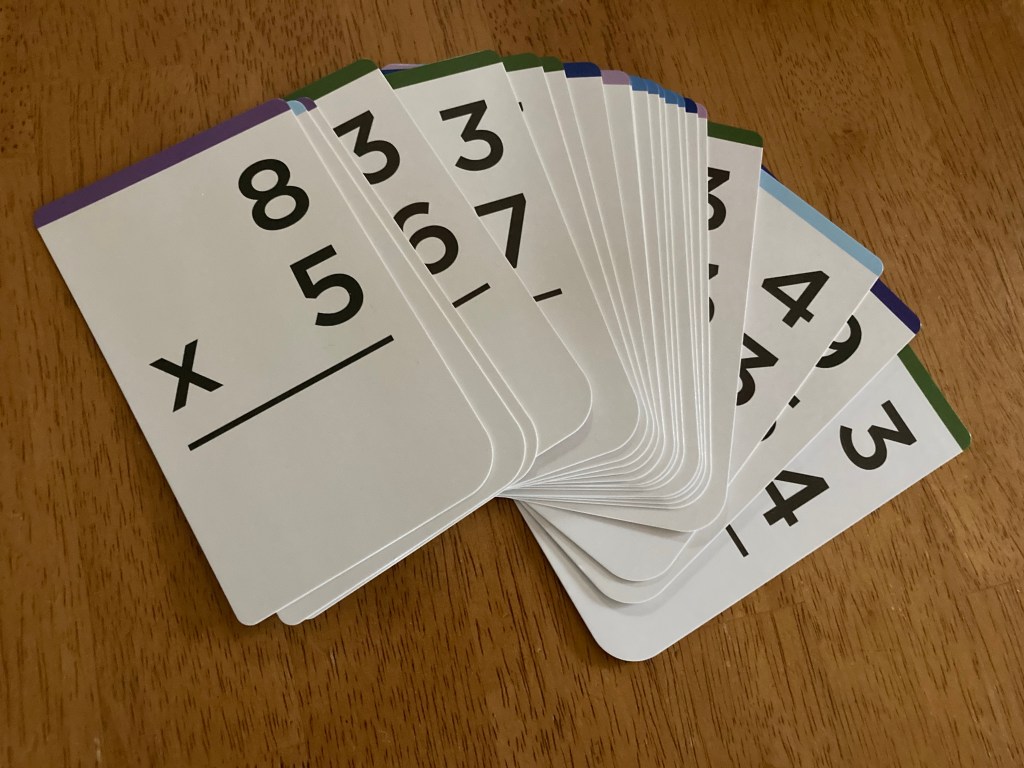
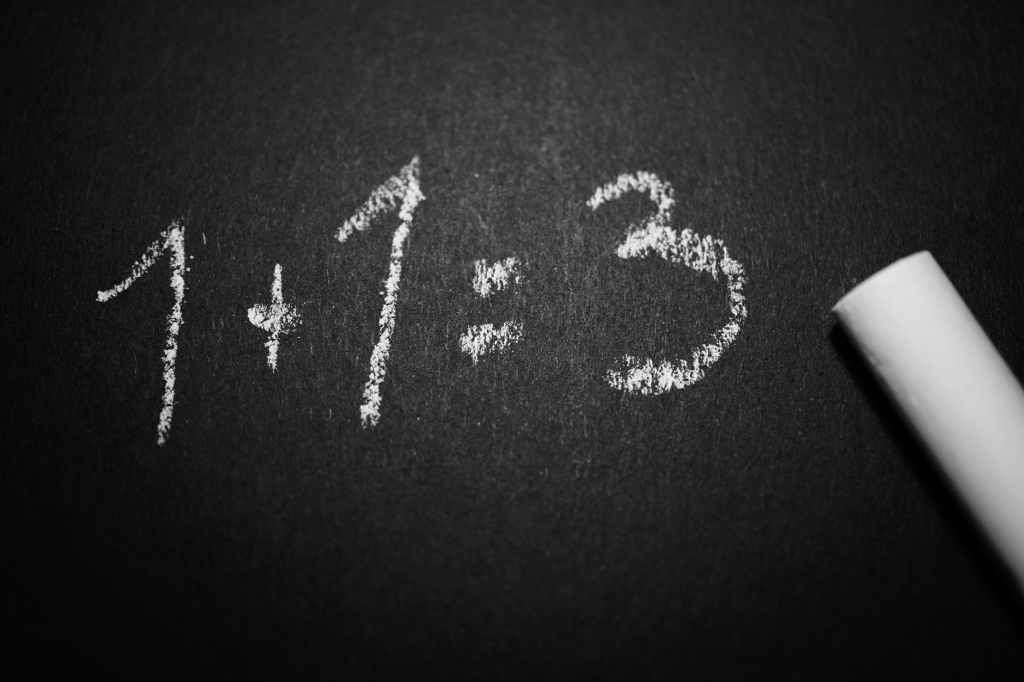
Other times, mistakes get engrained (accidentally). For example, think of a time, when you were a kid and you learned something–but you learned it wrong and you kept making the same mistake over and over. Frustrating! For me, it was 8 x 7. I really thought 8 x 7 was 54. I made the mistake, the mistake maybe wasn’t corrected (it was accidentally reinforced in some way), and so I made the mistake again and again. So, for a while, each time I answered that multiplication fact, I said 54. Finally, after many more mistakes, I relearned the correct answer (8 x 7 = 56). But it was so hard to stop that 54 from popping into my head when asked 8 x 7!!

multiplication card photo

Errorless learning, on the other hand, does not allow errors. When new information is introduced, like a new multiplication fact, a student is told the correct answer, first time. Then, the next time, maybe it’s told again. But on the third time, the teacher would wait a short bit of time (as in maybe 2 seconds, using a time delay) before telling the answer to see if the person is able to come up with it on their own. Key phrase: SHORT bit of time. With errorless learning, a teacher doesn’t wait for a student to make an error — to guess — in the hopes that the student now knows the answer. If the teacher waits 2 seconds and the student hasn’t yet stated the answer, the teacher would then give it and move on.

The other day, I was working with my son on his multiplication facts. He has learned in school how to solve them. He knows the strategies, and can come up with correct answers. Great!!! But he needs time in order to do so. As he is in 4th grade, math is, of course, becoming more advanced and they’re learning beyond just simple multiplication facts. At this point, it would be helpful if he memorized those last few stragglers that he can’t seem to remember (like 8 x 7, ha!).

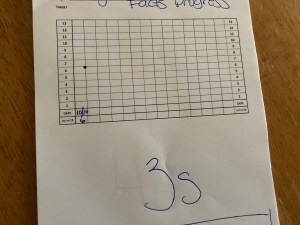
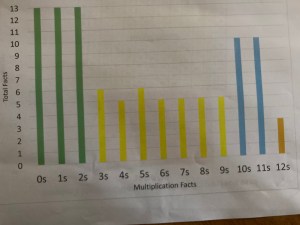
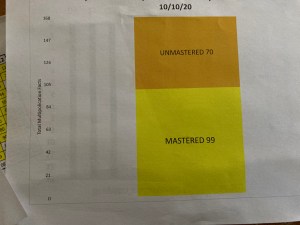
So, I set up a “program” for him. Because I do that sometimes. I analyzed his baseline data; I found out which facts he knew and didn’t know. I created graphs for him to visually track how much he learns over time (to help motivate him). I showed him the graphs to start. I filled a multiplication chart in yellow for the facts he knew and left the others blank. (Another visual way to track progress). I prioritized where to start, based on which facts he knew already.

When he and I sat down to work (and he’s super motivated to master the facts!! but that’s a different topic😊), I started trying to teach in an errorless way, just as I would introduce new information when teaching as a BCBA. I began flashing each multiplication fact card, stating the number sentence aloud, and then immediately giving him the answer.

He got angry. He was not happy that I told him the answer.

“I was going to get it! Why’d you tell me?!?!?!” he said.

His response told me that he has learned his job is to guess (or work it out in his mind) until he comes to the correct answer, and that process will lead him to his expected reinforcement (praise for answering). To him, I had taken away his opportunity for praise and the happy feeling of getting it correct, because I told him the answer without letting him try. Meanwhile, in the time he spent guessing, he could have gotten in about 5 errorless trials, which would build up and go into his memory for the next time (he’d be learning rather than guessing).

I explained my thoughts to him. I told him, it’s okay if I tell you the answer. I told him, watch and see, when we do this again and again you’re going to know the answer next time, without even thinking. He was skeptical but went along with it. We still need to practice more, but I am confident he will believe me after seeing his own progress soon!

This whole experience made me think, though. If kids were taught in this way more often (it’s not for everything— such as learning what multiplication is and what it really means to multiply—but certain things (like memorization of basic facts) would lend themselves well to errorless teaching) students may end up a lot less frustrated with learning. And again, don’t get me wrong, there’s more that goes into it than what I’ve just said… but I would be happy to answer any questions you may have about it. Let’s discuss!

When I was studying for the behavior analyst board exam, I went the errorless learning route as much as possible. I passed, first time…🤷‍♀️ I think it helped. (Also, there’s a wee bit o’ research that can tell ya more!)

Long story short, I’m telling you, when things need to be memorized use the hints you have and the resources around you.

Make sure you don’t guess!

Try to avoid making errors…

If you are at all unsure about something, FIND IT OUT FOR SURE before moving on.

Try it & let me know what you think. Errorless learning/teaching can, at least, be another tool for learning in your toolbelt!!

For BCBA-candidates…

I know trying to pass the board exam to become certified as a behavior analyst is tough!!! One of the services I offer is individualized study plans for those who wish to become certified. I use behavioral skills training and assessments to tailor the “programming” I create for you to meet your goal of passing the exam.

You may be thinking, “Wait… you’re going to analyze my studying behavior, my correct answers vs. errors in pre-tests, then you’ll use your assessments to help me change my behavior (increase my ABA skills) to meet my goal (passing)?”

Yep.

I know you were thinking exactly that. (Haha)

As my 9-year-old says: “Mind. Blown.”

One thing that helped me when I was studying was analyzing real-life scenarios. They helped to make abstract terms and concepts more concrete and understandable. For example, if I was working on identifying types of reinforcement and whether a reinforcer is a primary or secondary reinforcer:

Identifying types of reinforcement

In the following scenarios, consider how the child is reinforced and with what type of reinforcer:

1. Rachel knows that Jack is hungry. Jack answers three questions appropriately during their DTT session and then Rachel provides him with a pretzel. For each three to five questions Rachel asks Jack, she continues to provide him with pretzels as they work. Over time, Jack’s correct responding to questions has increased.

(Positive reinforcement; primary reinforcer)

2. Rachel knows that Jack has a history of enjoying tickles but previously would ask for tickles by placing a person’s hands on his stomach. When Rachel plays with him, each time he correctly asks for “tickle” or a close approximation of it, she gives him tickles and laughs with him. Now, he asks for tickles much
more frequently than before.

(Positive reinforcement; secondary reinforcer)

3. Jack’s mom told Jack to put on his coat before going outside in the snow. Jack did not listen to her and went outside to play anyway. A few minutes later, Jack came inside shivering, brought his coat to his mom and said, “coat,” requesting help to get it on. Jack then happily went back outside to play. The next time he wanted to go outside, he asked for “coat,” put it on, then went outside to play.

(Negative reinforcement (escaping cold) with primary reinforcer).

4. Jack’s mom kept having loud women over for hours on end. Jack hated the noise they made. He enjoyed listening to the birds outside while he played in his room. Jack began yelling loudly every time the women came over. Mom would then make them leave. Jack continued to yell every time a friend of his mom’s came over to the house.

(Negative reinforcement, secondary reinforcer (removal of people/noise)

I hope that was helpful!

Besides helping BCBA candidates create specific and individualized plans, I am fully qualified to supervise those needing to accrue hours to sit for the exam.

“Is this the right intervention?” A parent’s guide to determining if an intervention is evidence-based

What is Science?

Science seeks proof.

Science puts to the test ideas (hypotheses) by defining them carefully and measuring them accurately and objectively.

Science uses controlled experiments and, later, verifies what is learned to ensure it is valid. (Green, 1999, p. 5-6).

Science uses peer review once research is complete: a process in which other scientists test and check the results of experiments (“Sense About Science: I Don’t Know What to Believe,” 2005).

What is the scientific method?

The scientific method is made up of the following steps:

1. Identify a problem.

2. Gather relevant data and information.

3. Decide on a hypothesis or question.

4. Test the hypothesis or question. (Mayer et al, p. 5)

After these steps are complete, the scientist would then publish the results, which would be peer reviewed. After that, the findings would be either supported or questioned.

The scientific method leads us to factual evidence. When a method has been scientifically tested and validated, we can rest assured that it is proven it will work.

What is Applied Behavior Analysis (ABA) & why does everyone keep mentioning these things?

Applied behavior analysis (ABA) is the science of behavior. It is science with a focus on learning about what influences behavior. It is “an evidence-based method of examining and changing what people (and other living creatures) say and do” (Meyer et al, 2014, p. 4).

Behavior Analysts learn about what things, or variables, influence behavior in the real world.  They look at socially important issues and seek to describe them and address them (Meyer et al, p. 6).

But, Why ABA?

Because:

…ABA is the most extensively researched of all interventions for people with autism.

…Early intervention has been proven to increase a child’s IQ and living skills.

…ABA is proven to be effective in teaching specific skills. (“Recommendations of expert panels…”)

What makes up scientific evidence & support for intervention?

Evidence-based practice is when evaluation and treatment procedures are followed in deciding on an intervention. It uses the science behind a method and a disorder, a clinician’s expertise, and your preferences, as the family, for treatment.

If there is scientific evidence for an intervention, you know that that method has been studied carefully (Logemann).

Support for an intervention occurs when opinions, beliefs, or ideas are not just taken at face value, but instead, there are facts to rely on and data to support those facts. (Green, p. 5).

Deciding on a treatment for your child with autism is a very important decision!

Shermer (2002) states that there are many factors that influence our beliefs, and those factors don’t usually include science. For example, our backgrounds, personalities, family histories, levels of education, life experiences, and the overall society we live in affect our beliefs. As people, we tend to remember things that validate the beliefs we already have and discard things that do not support our beliefs, regardless of evidence. This is called confirmation bias.

It is easy to rely on how we feel about an intervention vs. the facts of the intervention.

Benefits of knowing that an intervention has scientific support:

When an intervention has scientific support, you know that it will:

1. Use your time and your child’s time wisely.
2. Use your money or that of your insurance company effectively.
3. Increase the chances of your child growing and succeeding.

Risks of using interventions without scientific support:

When an intervention does not have scientific support, it may:

1. Waste your time.
2. Waste your child’s time.
3. Waste money.
4. Cause emotional or physical harm.
5. Slow your child’s progress.
6. Cause additional problems that need to be solved.

Ensuring that an intervention is scientifically proven will help your child exponentially more than relying on something that is not!

Questions to ask when deciding on an intervention
Taken from Green (1999):

What is the intervention, precisely?


Exactly what is it supposed to do?


Have its effects been tested in controlled experiments using direct, objective measures?


Were those studies published in peer- reviewed scientific journals?


What did studies show about positive effects and negative side effects?


Did the effects carry over beyond the immediate treatment setting?


 Is there another scientifically validated treatment that is similarly effective but has fewer negative side effects?


Who will administer this treatment, and how can I be sure they are qualified to do so?


How will its effects on this individual be evaluated, and by whom?


What will happen if we do nothing?

For your reference & information:

Green, G., & Perry, L. (1999). Science, pseudoscience and antiscience. Science in Autism Treatment, 1(1), 5-6.

Logemann, J. What is evidence-based practice and why should we care? Science in Autism Treatment. Retrieved from https://www.asatonline.org/research-treatment/making-sense-of-autism-treatments-weighing-the-evidence/what-is-evidence-based-practice-and-why-should-we-care/

Mayer, G.R., Sulzer-Azaroff, B., & Wallace, M. (2014). Behavior Analysis for Lasting Change (3rd edition). Cornwall-on-Hudson, NY: Sloan.

Sense about Science (2005). I don’t know what to believe: Making sense of science stories. [Leaflet]. Retrieved from http://senseaboutscience.org/wp-content/uploads/2016/11/IDontKnowWhatToBelieve.pdf

Shermer, M. (2002, September). Smart people believe weird things. Scientific American. Retrieved from https://www.asatonline.org/research-treatment/making-sense-of-autism-treatments-weighing-the-evidence/smart-people-believe-weird-things/

Recommendations of expert panels & government task forces. Association for Science in Autism Treatment. Retrieved from https://www.asatonline.org/for-parents/learn-more-about-specific-treatments/applied-behavior-analysis-aba/aba-techniques/recommendations-of-expert-panels-government-task-forces/

What is ABA?

You probably know that applied behavior analysis (ABA) is a scientific, evidence-based “Best Practice” treatment for autism spectrum disorders, recommended by the US Surgeon General, The American Psychological Association, and many others.

When using behavior analysis, therapists work together with clients to improve specific behaviors (social skills, academics, communication, fine motor skills, self-care skills, chores, job completion, timeliness…) while reducing any problem behaviors. The principles of behavior science have repeatedly been proven to be effective for children and adults of various abilities and disabilities, and can be used in a variety of settings (schools, workplaces, homes, clinics). Research has shown that consistent ABA therapy can significantly improve skills and behaviors and, for those with disabilities, can decrease the need for specialized instruction and services.

You can learn more of the basics about what ABA is on the Autism Speaks website.

ABA, though, is not only for treating autism.

ABA is “a scientific method, a technology, and a professional approach. It is a system designed to analyze and change behavior in a precisely measurable and accountable manner. ABA is an evidence-base method of examining and changing what people (and other living creatures) say and do” (Mayer, Sulzer-Azaroff, & Wallace, 2014).

ABA can go beyond autism…

beyond any disability label

and can be used to help reach goals.

In our day to day lives as humans, we all may have behaviors that we want to increase or decrease, or skills we would like to develop, at home, at work, personally, or with a family member in mind… the path to a solution may begin with ABA.

Everything a person does is behavior.